
Industry Insights & Guides
Safety Net Installation Guide: EN 1263-2 & Fall Height
A net is only as safe as its installation. EN 1263-2 sets the fall height, catching width and fixing-point loads — get those wrong and the net cannot do its job.
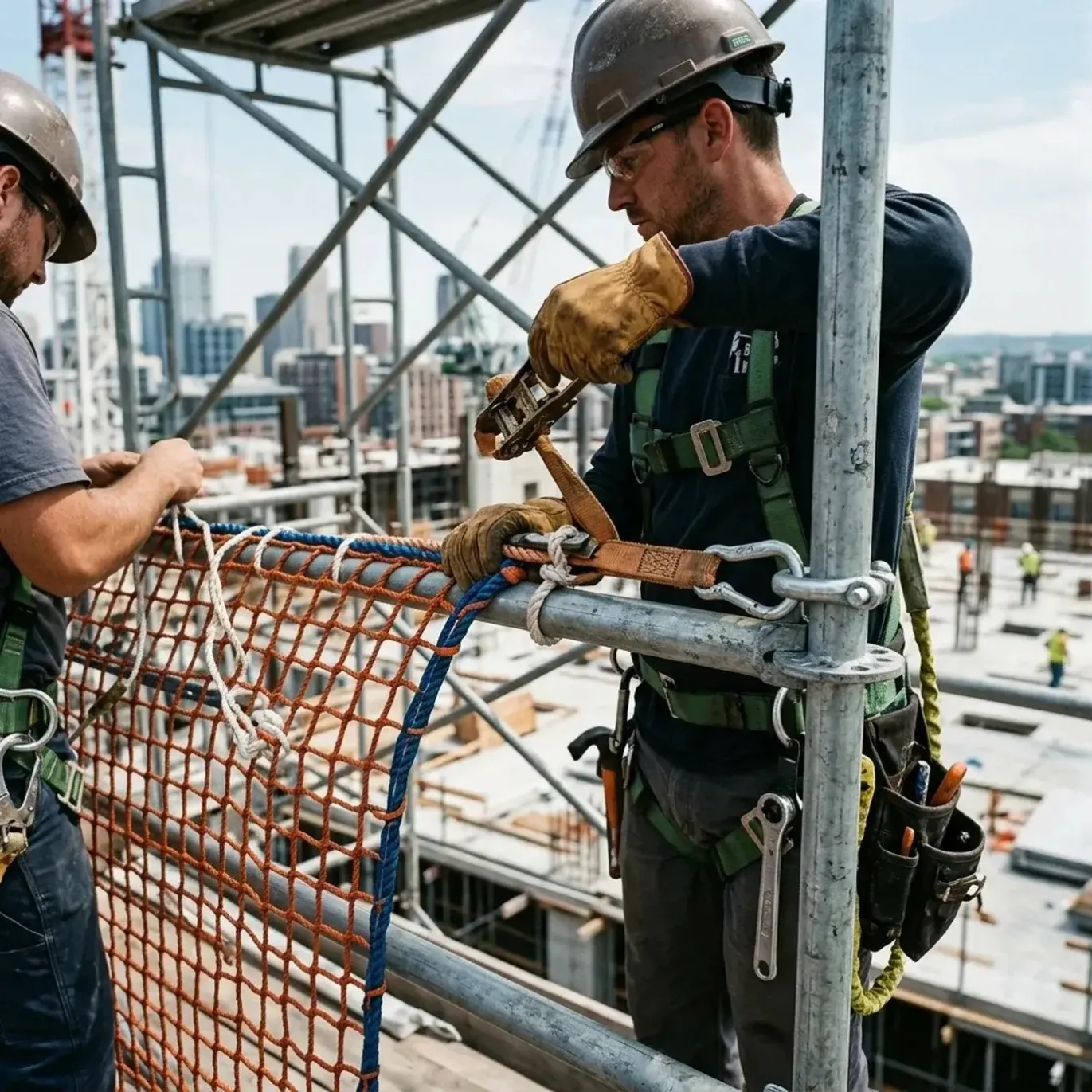
A safety net that is bought right and installed wrong is not a safety net. The mesh, the border rope and the drop test all belong to the net itself — EN 1263-1 covers those. But whether the net catches a falling worker depends on where it is put, how far below the work it hangs, how wide it reaches and what it is tied to. That is the job of EN 1263-2, the positioning standard, and it is the part buyers ask about least and installers get wrong most.
This guide covers the four numbers that decide an installation: fall height, catching width, fixing-point load and clearance underneath.
EN 1263-1 is the net, EN 1263-2 is the position
The two parts of the standard are a pair, and a net should never be specified with only one of them in mind:
- EN 1263-1 tests the net itself: mesh size, border rope, energy absorption and the drop test, and the label classes A1/A2/B1/B2 with systems S, T, U and V. The label guide on this site explains how to read it.
- EN 1263-2 sets the positioning limits: how far a worker may fall into the net, how far the net must extend beyond the edge of the work, how strong the anchorages must be and how much room must be left below the net.
Every consignment of netting should arrive with an instruction manual covering exactly those points — required anchorage forces, maximum fall height, minimum catching width, net linkage, minimum distance below the net, storage, examination and replacement. If the manual is missing, ask for it before the net goes up, not after.
Fall height: 6 metres at most, 3 metres near the edge
The fall height is the vertical distance between the working position and the net. EN 1263-2 allows a maximum fall height of 6 metres into the net — which corresponds to a nominal fall of 7 metres measured from a person's centre of gravity. That 6-metre figure is a ceiling, not a target: nets should be erected as close as practicable below the working level, and good practice is to keep them within about 2 metres of the work where the structure allows it. A shorter fall means a smaller impact on the worker, on the net and on the anchorages.
There is a stricter limit where it matters most. Within 2 metres of the net's outer edge, the fall height must be no more than 3 metres. A worker who falls near the edge has less net to land on, so the standard cuts the permitted fall there in half. Any installation plan that treats the whole net as a 6-metre zone is wrong at the edges.
Local rules can be stricter still — in Australia, for example, the maximum fall height applied in practice is 2 metres — so the local regulation and the manufacturer's manual govern alongside EN 1263-2, whichever is stricter.
Catching width: the net must reach past the edge
A net that ends at the edge of the work does not catch a worker who falls outwards. EN 1263-2 therefore sets a minimum catching width — the horizontal distance the net must extend beyond the edge of the working area — and the required width grows with the fall height. The higher the fall, the further a falling person can travel sideways, and the wider the net must be.
For a system S net, the standard also sets a minimum size: at least 35 m², with the shortest side at least 5 metres. Smaller nets fall outside the positioning rules of EN 1263-2, which is itself a warning — a small net rigged as a catch-all is not a compliant installation.
Fixing points: 6 kN each, no more than 2.5 metres apart
The net is only as strong as what it is tied to. Under EN 1263-2, each anchorage point must be capable of bearing a characteristic load of at least 6 kN, calculated at a 6-metre fall height and assuming the load acts at 45° to the horizontal. The distance between anchorage points must be less than 2.5 metres. Tie ropes fastening the net to the structure should have a minimum tensile strength of 30 kN and be tested to EN 1263-1.
Three points follow from those numbers that are easy to get wrong on site:
- Anchorages are a structural question, not a netting question. A 6 kN point needs a structure that can take it — a scaffold tube, a concrete edge or a purpose-designed anchor, verified by a competent person. Tying to whatever is handy is not an anchorage.
- Spacing matters as much as strength. A strong point every 4 metres leaves the net unsupported between points; the 2.5-metre limit is part of the load calculation, not a suggestion.
- The net must be fixed with no gaps. Nets should be rigged with no gaps between them; gaps of up to 100 mm are permitted, and up to 225 mm only in exceptional circumstances. A gap is a hole a worker can fall through.
Clearance below: the net needs room to work
A net stops a fall by deflecting — it forms a pocket and stretches. That means there must be enough clear space underneath the net for the deepest deflection, with nothing the falling worker could strike: no stored material, no plant, no protruding steel. The minimum distance below the net is one of the figures the instruction manual must state, and it grows with the fall height. A net rigged tight against a floor below it has nowhere to deflect, and a worker can hit the floor through the net.
The same logic applies to what is left in the net. Debris, tools and offcuts must be cleared regularly — a net full of rubble is both a hazard to anyone who falls into it and extra weight that changes how the net deflects, as the inspection guide on this site explains.
Before the net goes up: a short checklist
- Is the net's EN 1263-1 label present, and does its class and system match the job?
- Is the instruction manual on site, with anchorage forces, fall height, catching width and clearance below?
- Is the fall height 6 metres or less — and 3 metres or less within 2 metres of the edge?
- Does the net extend far enough past the working edge for the fall height (catching width)?
- Is every anchorage point rated for at least 6 kN, spaced under 2.5 metres, with 30 kN tie ropes?
- Is there clear space below the net for its full deflection, with no obstacles and no stored material?
- Are the nets joined with no gaps, and has the whole installation been inspected before first use?
What to ask your supplier
Before ordering, ask these six questions and keep the answers with the net's label:
- Does the net come with its EN 1263-2 instruction manual — anchorage forces, maximum fall height, catching width and clearance below?
- What system is this net (S, T, U or V), and what fall height is it positioned for?
- What anchorage load and spacing does this installation need, and what does the fixing hardware need to be?
- What is the minimum catching width at our fall height, and is the net large enough (35 m² minimum for system S)?
- How is the net joined to its neighbours, and what gap is permitted?
- Who inspects the installation before first use, and how often is it re-inspected?
If a supplier can sell the net but cannot answer the positioning questions, the net has been sold without its installation — and the installation is where the protection actually happens.