Combined Safety Net Systems: Debris Liners, Fans & Catch Nets
A practical guide to pairing a personnel fall-arrest net with a debris liner, and to using safety-net fans and catch nets on high-rise work.
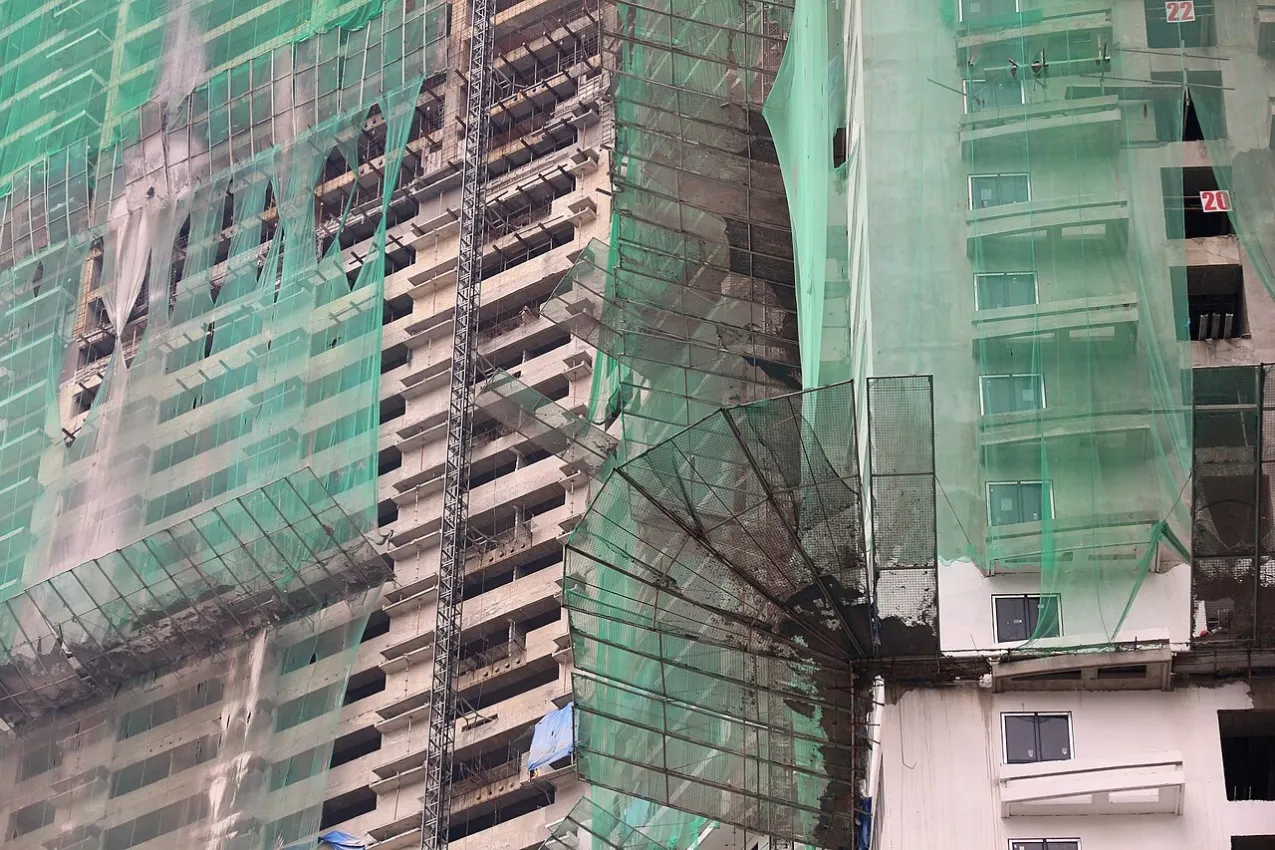
On a busy construction site, a fall-arrest net and a debris net do two different jobs. A personnel safety net is designed to catch a falling person. It is not designed to stop the small tools, bolts, offcuts and dust that fall from work above. That is why many sites use a combined system: a personnel net as the main fall-arrest layer, plus a debris liner, and — where the edge needs it — a safety-net fan or catch net projecting out from the building.
This guide explains what each layer does, how the layers work together, and what to check before you buy.
Why a personnel net alone does not stop debris
A personnel fall-arrest net is built to absorb the energy of a falling person. Its mesh is deliberately open — commonly around 60 mm or 100 mm in the systems described in EN 1263-1 — so that it can deflect, stretch and spread the load. That open mesh is exactly the problem for debris: a spanner, a bolt, a piece of cut timber or a handful of screws can pass straight through it.
A debris liner, also called a debris net layer, adds a fine-mesh sheet to the system. It is intended to contain small objects and to reduce the amount of dust and small material that falls to the levels below. It does not turn the personnel net into a different product, and it does not replace the fall-arrest layer: the two layers have different jobs, and both must be specified, installed and inspected.
Buyers should also think about wind and dust. A fine liner catches more air than an open net, so it increases wind load on the fixings and on the structure. On a dusty or windy site, a liner can also collect dust and fine material, which adds weight and can make inspection harder if it is not cleaned and checked regularly. That is a design and maintenance question, not a reason to leave the liner out — but it must be allowed for when the system is planned.
How a combined system is assembled
In a combined system, the personnel net remains the primary fall-arrest layer. It should be installed, tensioned and anchored in line with EN 1263-1 and, where it applies, OSHA 1926.502, and with the net manufacturer's instructions. The debris liner is then attached to the personnel net so that the two layers move and load together, without gaps at the edges where debris could escape.
Whether the liner sits above or below the personnel net depends on the system and the job. In many installations it is fitted on the underside of the personnel net, so a falling person meets the fall-arrest layer first; in other cases it is fitted above, to contain debris at source. Follow the system manufacturer's instructions for the product you buy, and do not change the arrangement on site without checking with the supplier.
Three details deserve particular attention. First, the border rope and the fixings: the liner must be tied or clipped to the personnel net and to its border rope at the intervals the manufacturer specifies, so that it cannot sag, billow or pull away and leave an opening. Second, the edges: the combined layers must close the gap to the structure or to the next net, with no unprotected slot for tools to fall through. Third, inspection and test-mesh access: the liner must not cover the personnel net's test meshes, labels or inspection points. If you cannot reach a test mesh, read a label or see the condition of the fall-arrest net, the liner is in the wrong place or fitted the wrong way.
Safety-net fans and catch nets
A safety-net fan, also called a catch net, is a different arrangement from a horizontal personnel net. It is an inclined or angled net that projects outwards from a building edge, usually from a floor edge or a facade, to catch falling people and objects before they reach the ground or a lower level.
Fans are used where work is carried out at height on the outside of a building — high-rise construction, facade work, cladding and glazing, and repair work on tall structures. They are often installed at intervals up the building, so that a fall from one section is caught by the fan below it, and so that falling objects are intercepted before they can travel far.
The difference from a horizontal personnel net is one of position and purpose. A horizontal personnel net is installed close below the working level, inside the structure or across an opening, to arrest a fall as soon as possible. A fan projects outwards and is angled, so that it intercepts a fall from the edge and deflects the falling person or object into the net rather than letting it drop clear of the building. A fan does not replace a horizontal net where the work needs one, and a horizontal net does not do a fan's job at the building edge. On many high-rise jobs the two are used together: horizontal nets inside, fans outside.
Because a fan is mounted on brackets or supports fixed to the structure, its fixings, projection and angle matter as much as the net itself. Ask the supplier how the fan is supported, what the fixing points must carry, and how the net is replaced or inspected once it is in place.
Choosing the right combination
Start with the fall-arrest layer. Check its mesh size and its energy class under EN 1263-1, and confirm that the class matches the fall height and the work it will be used for. Then check the liner on its own terms: its mesh opening, its weight in grams per square metre, and whether it is supplied as a liner for that personnel net or as a separate debris net. A liner that is too heavy or too fine for the installation can overload the fixings; a liner that is too open will not contain the debris you are trying to stop.
Compatibility is the point that is most often missed. The two layers must be compatible in size, in the way they are joined, and in the loads they put on the same anchors and border rope. Ask the supplier to confirm, in writing, that the liner is suitable for use with the personnel net you are buying, and that the combined system has been supplied and installed as a system before — not simply two products sold in the same order.
Finally, plan inspection and retirement for each layer separately. A personnel net and a debris liner age at different rates: the liner is often exposed to more sun, dust and abrasion, and may need to be replaced sooner. Inspect both layers, keep the test meshes of the fall-arrest net accessible, and retire each layer when its own condition, its inspection record or the manufacturer's instructions require it — not when the other layer is replaced.
Buyer checklist
- Confirm the fall-arrest layer's mesh size and energy class, and that it matches the fall height and the work.
- Check the liner's mesh opening and weight, and what size of debris it is intended to contain.
- Ask the supplier to confirm that the liner and the personnel net are compatible as a combined system.
- Check the border rope, fixings and tie intervals for both layers, and allow for the extra wind load of the liner.
- Make sure the liner leaves the test meshes, labels and inspection points of the personnel net accessible.
- For a fan or catch net, ask about its projection, angle, supports and fixing loads.
- Plan inspection and retirement for the personnel net and the liner separately.
- Ask what installation instructions, inspection guidance and labelling come with the system.
A combined system is not simply a net with an extra sheet on it. It is two layers, each with its own standard, its own inspection and its own working life, installed so that they protect people and the levels below at the same time. Specified that way, a personnel net, a debris liner and — where the edge calls for it — a safety-net fan give a site fall protection and debris containment in one planned system.